







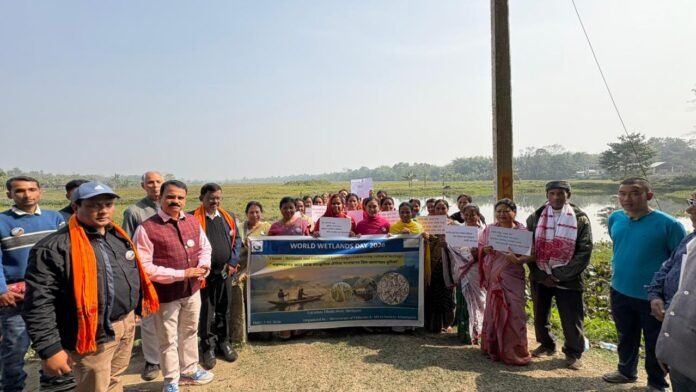



Community Awareness Programme at Tihulia Beel
To mark World Wetlands Day 2026, the Directorate of Fisheries, Assam, in collaboration with the ARIAS Society, organised a community-based awareness programme at Tihulia Beel in Morigaon district. The programme, organised by District Fishery Officials of Morigaon, focused on raising awareness about wetland conservation, sustainable management practices, and the critical role wetlands play in supporting local livelihoods.
Focus on Wetlands and Fisheries-Based Livelihoods
Addressing the gathering, Dr Sanjay Sarma, District Fisheries Development Officer, Kamrup, highlighted the ecological importance of wetlands and their contribution to fisheries-based livelihoods. This was followed by a key address by Dr Ramendra Chandra Barman, Deputy Project Director, SWIFT Project, who underscored the strong link between wetlands, food security, and the need for community-led conservation approaches.
Community Engagement and Traditional Knowledge
An interactive discussion session was facilitated by Ms Sheetal Sharma, Social Safeguard Specialist, ARIAS Society. The session actively engaged local communities in discussions on traditional wetland-use practices, emerging challenges, and sustainable solutions. The programme emphasised the value of indigenous knowledge systems in wetland conservation and witnessed enthusiastic participation from community members.
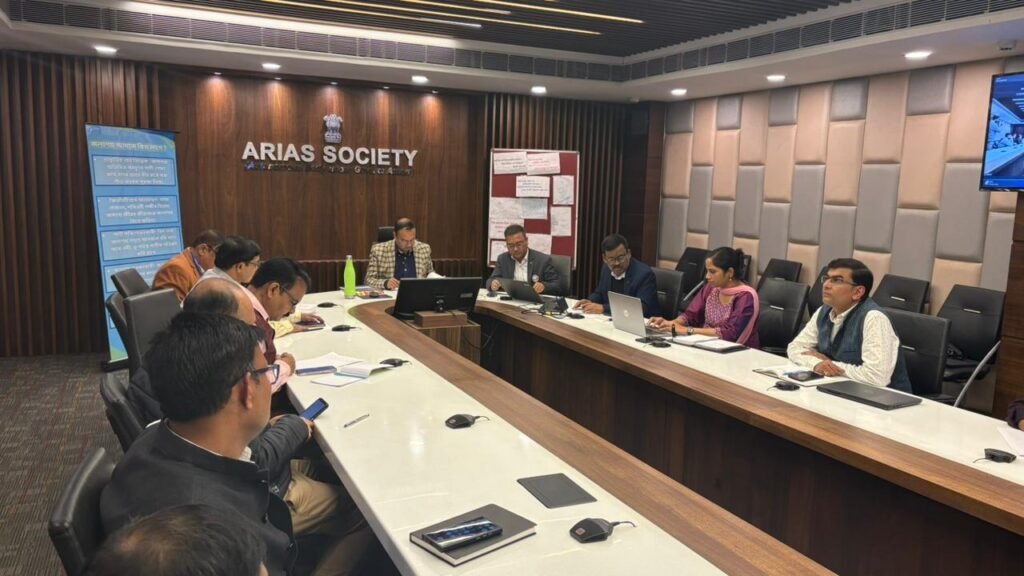
Technical Session on Wetland Management in Guwahati
Later in the day, a technical session on wetland management was held at the ARIAS Society Conference Hall, Guwahati. The session was chaired by Virendra Mittal, IAS, State Project Director, ARIAS Society, in the presence of Gauri Sankar Das, ACS, Director of Fisheries, Assam. Speakers highlighted the need for integrated, science-based, and participatory approaches to wetland governance.
Expert Insights and Way Forward
Expert inputs were shared by Dr Ajgarh Nawab from Wetlands International South Asia and Dr B K Bhattacharjya of ICAR-CIFRI. The session was anchored by Dr Ramendra Chandra Barman, who, in his opening note, stressed the importance of adopting comprehensive wetland conservation and management strategies. The discussions reaffirmed Assam’s commitment to safeguarding wetlands through collaboration between government agencies, experts, and local communities.
The programme also served as a platform to sensitise communities on the increasing pressures faced by wetlands due to unplanned resource use, encroachment, pollution, and climate variability. Officials highlighted how such challenges directly impact fish productivity, biodiversity, and the long-term sustainability of livelihoods dependent on wetland ecosystems.
Special emphasis was placed on promoting responsible fishing practices, habitat protection, and seasonal conservation measures to ensure ecological balance. Community members were encouraged to actively participate in conservation initiatives and align traditional practices with scientific management approaches for improved outcomes.
Speakers reiterated that wetlands like Tihulia Beel act as natural buffers against floods, help recharge groundwater, and support a wide range of aquatic and avifaunal species. Protecting these ecosystems was described as essential not only for fisheries development but also for climate resilience and environmental security in the region.
The technical deliberations in Guwahati further explored policy frameworks, institutional coordination, and data-driven planning for wetland governance. Participants discussed the importance of convergence between fisheries, environment, water resources, and rural development departments to achieve holistic wetland management.
Experts also stressed the need for regular monitoring, community capacity building, and the use of scientific assessments to guide restoration and conservation interventions. Successful models from other regions were cited to demonstrate how participatory governance can lead to improved wetland health and socio-economic benefits.
The World Wetlands Day 2026 observance concluded with a reaffirmation of the commitment to protect Assam’s wetlands through inclusive, science-based, and community-driven approaches. The initiative underscored the shared responsibility of government agencies, experts, and local stakeholders in ensuring the sustainable management of wetlands for future generations.
The event reinforced the significance of aligning policy, science, and community participation for effective wetland conservation. It also highlighted the role of awareness programmes in empowering local stakeholders to become custodians of their natural resources. Such initiatives are expected to strengthen sustainable fisheries development while safeguarding Assam’s rich wetland ecosystems. The observance marked a meaningful step towards long-term, inclusive, and resilient wetland management in the state.