







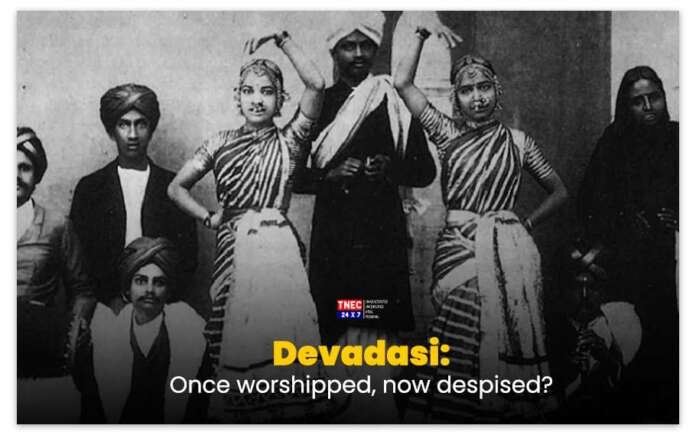



Devadasi, a female artist who was dedicated to worship and serve a deity or a temple for the rest of her life.
These Devadasis were married to a temple just after they hit puberty and after this they remain loyal to the goddess that they worship for the entire life. They do not get married again or commit themselves to one man or one relationship.
If we sneak into the past, we can find that in the Devadasi culture, Devadasis had a lot of respect and cultural value. However, with the changing time these Devadasis have been treated as sex workers and are widely subjected to social exploitation.
About the Devadasi System
The Devadasi practice has been a part of the Hindu society for centuries. The process of dedicating a Devadasi to the goddess involves a traditional ceremony and is performed before the girl hits puberty.
After the ritual she is considered married to the deity and is not allowed to marry a mortal for the rest of her life. The goddess is known by several names including Yellama and Huligemma. The story of the Yellamma goddess is long and convoluted yet surreal.
The whole ordeal began when Yellama’s son was ordered to chop her head off by her husband after he caught her spying on two people getting frisky by a lake. After a complex process of death and reincarnation, the goddess Yellama was born.
According to the legend, the Goddess Yellama, fled to the villages of Karnataka and subsequently became a symbol of worship for the lower Hindu castes. Every year, an older Devadasi woman acts as a medium between the deity Yellamma and her worshippers during a session at the Yellamana Jatre in Saundatti, India.
The Jogati, the elderly woman enters a trance like state and the devotees watch in awe as the deity Yellama begins to speak through her. The medium cries out, shakes uncontrollably and often collapses at the end of the session.
This provides the worshippers with direct contact with the deity, and the woman is duly compensated. These mediums are central to perpetuating the rituals of Yellamma and recruiting new young Devadasi girls.
Origin of the system
It is said that the concept of Devadasi came into the picture during the time of the great Gautama Buddha, when a particular king summoned Amrapali and assigned her to a particular temple. The tradition of the Devadasi culture can be traced back to the 6th century AD, the period when a lot of kingdoms flourished in India.
During the times of the Chola Empire, these Devadasis were treated with immense respect and had a very high social status. They would receive appreciation or compensation for performing in the king’s court by way of gold, silver or land.
The Devadasis had certain duties and responsibilities that they had to perform for the temple. They also travelled with the King, contrary to the wives, implying that the Devadasis had more rights or authority than those of the King’s wives.
Currently, however, there are children as young as six years of age, who get trapped into the Devadasi culture. These girls have no choice in the matter since they are not educated enough to fight the rigid system.
Prevalence
The system prevails across Tamil Nadu, Karnataka, Andhra Pradesh, Maharashtra, Orissa and Assam predominantly. Ancestrally, the Devadasis were not identified as a separate caste.
Hierarchy
The girls belonged to different castes and hailed from different regions. But caste played a crucial role and formed a hierarchical order within their structure. Traditionally, the Devadasis were categorised into ritualistic and non-ritualistic performers.
Ritualistic performers were from the upper caste while the ones from the lower caste were assigned menial jobs such as washing, cleaning the temple and fanning the deity. The nature of work was defined by their caste.
Upper caste women were taken as courtesans while the lower caste women were identified as commercial prostitutes. Over the course of the past centuries, the practice gradually shifted to lower caste communities where only Dalit girls were dedicated to the temple deity. This led to further exploitation of lower caste women by the upper caste men.
The efforts to abolish the system began as early as the 1800s by reformists and social activists. Laws were passed in the country making it illegal and a punishable offence. Yet, till date instances of girls being involved in this system are being reported.